
KOBIL AI
Assistant.
One governed assistant inside the SuperApp. Ask questions, query connected tools, and build toward cross-MiniApp workflows with identity, audit, and connector governance from AgentBox.
Live in mPower today. Expanding into governed cross-MiniApp workflows.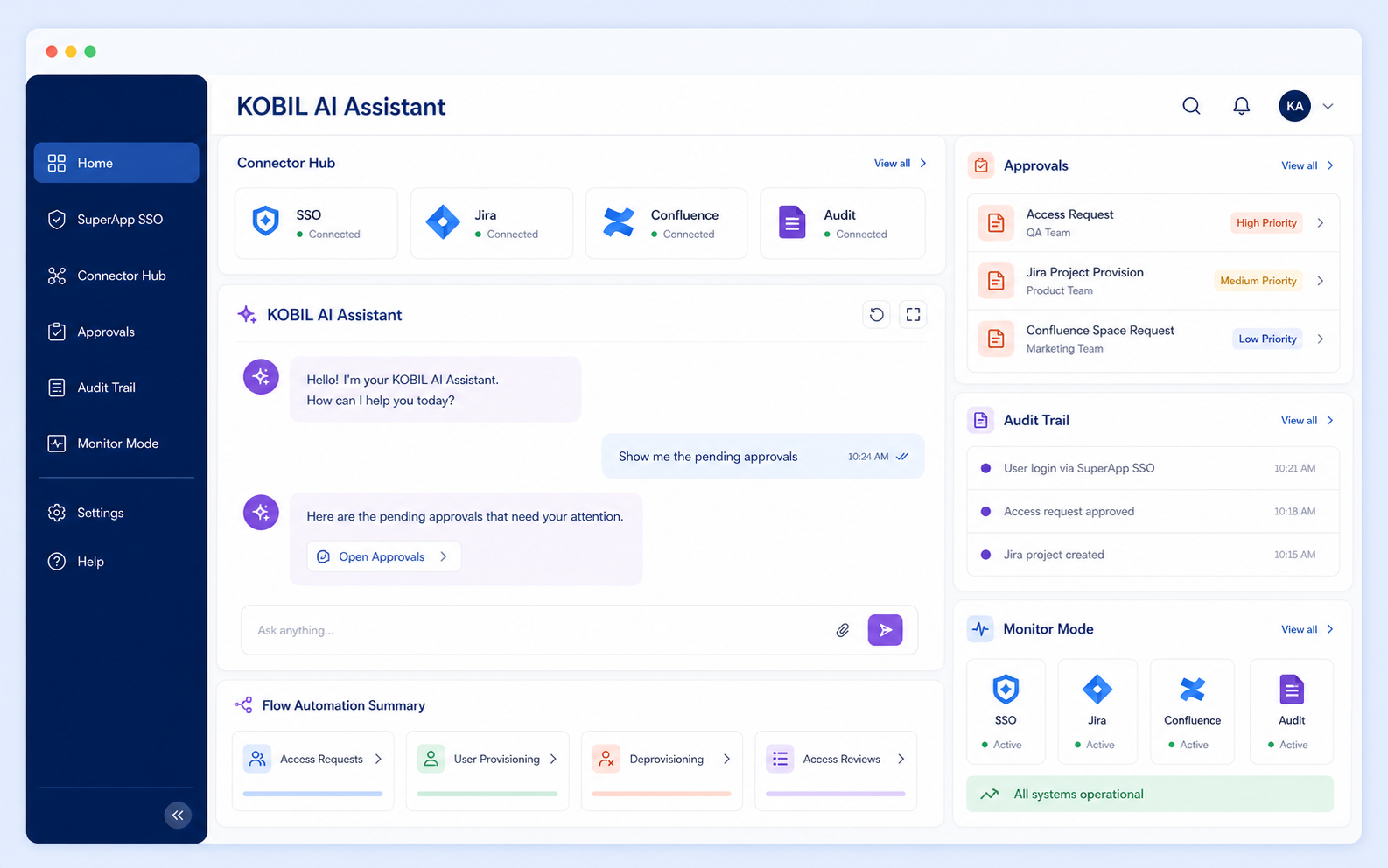
Enterprise SSOKeycloak OIDC and silent sign-in
Audit visibilityConnector and approval events
KOBIL digital trust infrastructure
Product definition
Governed chat,
Governed chat,
inside mPower.
KOBIL AI Assistant is a productized AgentBox assistant surface for the SuperApp. It is live as a chat MiniApp with real SSO and a production connector portfolio, while broader cross-MiniApp action is the next product direction.
Product scope
Today, the assistant delivers SSO-backed chat, governed connector access and audit visibility. The product direction extends this foundation into cross-MiniApp workflows and enforced approval for sensitive actions.
One SuperApp-aware session
Real Keycloak OIDC, PKCE and silent login support let the assistant avoid a separate user experience where SuperApp SSO is configured.
Tool access through governed routes
Jira, Confluence and the partner MiniApp portfolio are live through governed production connector paths.
Audit-first product surface
Interactions, connector activity and approval records create a traceable operating record, with enforced approval controls extending that foundation.
Capability readiness
Connected today.
Connected today.
Built to expand.
Live production capabilities and the next product extensions are presented in one clear operating view.
SuperApp SSO and chat
Real Keycloak OIDC, silent SSO behavior, session verification and the working chat experience are live.
Jira and Confluence
Live production access runs through the governed VPN connector path.
Candor, Herald, Todo
Production connectors call each MiniApp's live backend using real-mode, per-user token exchange.
Personio, Teams, Timebutler, Kolay
Production connectors provide live governed access to HR, collaboration and workforce systems.
Audit and approvals
Approval requests, decisions and tool activity are visible today, with enforcement continuing as a product rollout step.
Cross-MiniApp acting
The next product layer will coordinate app-owned actions as MiniApps expose governed callable interfaces.
Production intelligence
Engineering and domain agents.
Source-control workflows and specialized RAG agents run through the same SecureProxy, managed MCP policy and audit foundation.
GitHub + GitLab
GitHub repository, issue and pull-request workflows are production-enabled. GitLab follows the same governed source-control pattern as the next adapter.
GitHub live · GitLab nextSpecialized Agents + RAG
Domain-specific assistants are grounded in approved knowledge through SecureProxy-backed embeddings, Chroma retrieval and governed MCP access.
Production readySafety Controls
SecureProxy, MCP policy checks, audit events, workspace controls and skill scanning keep agent execution on governed paths.
Operational foundation
Reference architecture
Identity in front.
Identity in front.
Governance around tools.
The assistant sits inside SuperApp, but execution and connector behavior are shaped by AgentBox runtime, MCP bridge, audit and policy services. Coverage depends on registered routes and configuration.
SuperApp OIDC identity and session verification
Runtime adapters for assistant chat execution
Managed MCP bridge for connector calls
Approval records and audit stream
Identity brokerOIDC, PKCE, session checks
MCP bridgeManaged connector routing
Approval monitorAdvisory visibility today
Audit streamNormalized evidence events
SuperApp user
Opens the Assistant MiniApp with SSO-backed identity.
KOBIL AI Assistant
Chat, runtime routing, connector governance, approval visibility and audit events.
- Authenticate01
- Route request02
- Call connector03
- Record evidence04
Tools and MiniApps
Live, activating and product-expansion providers stay explicitly labeled by rollout stage.
One conversation.
Many app-owned workflows.
The long-term model is for MiniApps to expose structured tool surfaces that the assistant can call with user-scoped identity. That keeps each MiniApp responsible for its own business rules while AgentBox supplies the assistant, governance and audit path.
Vacation Requests
Travel and Expenses
CapEx Proposals
On-Call Billing
Document Signing
Deployment options
One assistant.
One assistant.
Runs beyond mPower too.
The SuperApp MiniApp is one deployment mode of the same governed AgentBox assistant stack, not the only one the architecture supports. The identical chat, connectors, skills/flows and audit foundation is also built to run standalone, independent of mPower.
SuperApp MiniApp
Live today in staging and production. Runs inside the mPower webview with silent SuperApp OIDC sign-in.
Your own Kubernetes cluster
The same stack deploys on a customer-operated cluster behind a customer-chosen hostname, with the runtimes and connectors you choose. Built into the deployment architecture today.
KOBIL-hosted, standalone
A KOBIL-hosted deployment mode of the same stack, independent of the SuperApp -- reached directly in a browser, no SuperApp account required.
Access model
Every mode is a zero-install browser experience on any device -- there is no separate desktop application. Sign-in falls back automatically to direct email/password login whenever SuperApp single sign-on isn't present, so the standalone modes need no separate build.
Roadmap focus
Turn foundation
Turn foundation
into enforced workflow.
The next product moves are operational, not decorative: enforce approvals, complete connector prerequisites and choose one MiniApp pilot with a real callable interface.
Governance
Enforce
Extend visible MCP approval activity into enforced decision gates for sensitive actions.
- Pause risky calls until decision
- Preserve audit trail
- Test denial and timeout paths
PilotRecommended
MiniApp
Select one workflow MiniApp and expose a structured provider interface the assistant can safely consume.
- Define owner and success criteria
- Validate app-to-app identity path
- Ship one narrow production workflow
Connectors
Expand coverage
Add new governed tools and MiniApp interfaces on top of the live production connector portfolio.
- Prioritize high-value systems
- Reuse identity and policy patterns
- Validate production outcomes
Each rollout step is scoped against one owned workflow, its connector path and measurable production success criteria.
Indicative pricing
Start with one workflow.
Start with one workflow.
Scale with proven value.
KOBIL AI Assistant starts with a defined technical engagement, then moves to an annual model based on deployment, workflows and governed connector scope.
Entry engagement
Workflow assessment
€4,500one-time
A focused technical and product assessment for one high-value assistant workflow.
- Workflow and ownership definition
- Identity and connector readiness
- Deployment recommendation
- Pilot scope and success criteria
Recommended
Production pilot
€18,000fixed scope
A structured rollout of one real workflow with production identity, connectors and governance.
- One owned business workflow
- Selected production connector path
- SSO, policy and audit configuration
- Measured findings and rollout plan
Enterprise
Enterprise deployment
From €72kper year
A governed assistant deployment scaled across approved teams, workflows and environments.
- KOBIL-hosted or customer-hosted
- Connector and workflow scope
- Security and operating model
- Support and rollout planning
Indicative terms
Indicative prices exclude VAT. Infrastructure, model-provider usage and exceptional integration work are scoped separately. Final commercial scope depends on deployment model, active users, connector and workflow coverage, and support level, and is subject to technical assessment and product readiness.
Product whitepaper
Technical depth.
Technical depth.
Product direction.
The complete product brief covers architecture, identity and governance, deployment options, the connector model, product roadmap and commercial approach.
KOBIL AI Assistant FAQ
Clear answers.
Clear answers.
Practical details.
What is KOBIL AI Assistant?+
It is the governed chat assistant embedded in the KOBIL SuperApp/mPower experience, built as a productized instance on the AgentBox runtime, connector and security stack.
What works today?+
SuperApp SSO, the chat experience, audit events and the production connector portfolio are live. This includes Jira, Confluence, Candor, Herald, Todo, Personio, Teams, Timebutler and Kolay.
How will it work across MiniApps?+
The product direction connects MiniApp-owned callable interfaces through platform identity and governed tool paths. The rollout starts with one owned workflow and expands as MiniApps expose those interfaces.
How are sensitive actions governed?+
Approval activity and tool events are visible and auditable today. Enforced decision gates for sensitive MCP actions are part of the product rollout.
Which connectors are ready?+
Jira, Confluence, Candor, Herald, Todo, Personio, Teams, Timebutler and Kolay are live in production. GitHub engineering workflows are production-enabled, specialized Knowledge Base/RAG agents are production-ready, and GitLab is the next governed source-control adapter.
What should the first pilot be?+
A narrow workflow MiniApp with clear ownership and measurable manual-work reduction, such as vacation requests, travel/expense handling, CapEx proposals, on-call duty billing or document signing.
How is KOBIL AI Assistant priced?+
Indicative pricing starts at €4,500 for a one-time workflow assessment, €18,000 for a fixed-scope 8-12 week production pilot, and €72,000 per year for an enterprise deployment. Final pricing depends on hosting model, active users, connectors, workflows, support and model-provider consumption.
Do I need the mPower SuperApp to use it?+
No. The SuperApp MiniApp is the most integrated way to use it today, but the same assistant stack is also built to run standalone in a browser -- self-hosted on your own Kubernetes cluster, or as a KOBIL-hosted deployment -- with its own sign-in, independent of mPower. There is no separate desktop application; standalone access is zero-install, in any browser.